Monday, November 14, 2016

Intensive Shanghai visit

Our train journey to Shanghai went very smoothly indeed. So far, I've been rather impressed with public transport in China. The metro systems we'd used (in Shanghai, Nanjing and Hangzhou) all functioned pretty much flawlessly (even if the ever-present security checks are a bit annoying), and the bus/train services function very well indeed. Some so called developed countries could learn from these guys...

Anyway, once in Shanghai, we headed off to the apartment block, where we were supposed to meet up with Isabelle. And she did indeed arrive pretty quickly, and once we'd gotten settled in, we decided to hit the road, to find a bit of food to fill our growling stomachs. 

We walked across to the French concession (which is supposed to be a good area to grab some food) - and we ended up in a place serving hot pot. Unfortunately, they only had a menu in Chinese, so we ended up going for the "let's just tick off 10 things randomly off the menu and hope for the best" strategy. It turned out to be an only partial success, at least as far as Nick and Isabelle were concerned, as most of the stuff they brought strongly resembled brain tissue and strange organs. Be as it may, I rather enjoyed it!

The food bit done, we headed over to a nice pub, where we had a few beers, catching up on the latest news (a lot of it, unfortunately, about the American elections). Anyway, great to have Isabelle onboard for our travels!

The next day, we got up bright 'n early, eager to explore Shanghai. We started off by checking out Jing'An temple, as it was located just down the road from the apartment we were staying at. It's a pretty calm place to escape the hustle and bustle of Shanghai. Actually, it's a very busy temple, but most of the visitors are actually real worshippers rather than selfie-snapping tourists. An impressive place - and the place does have an illustrious history going back to the 12th century, too!

After a quick coffee at a funny animal themed place (well, I actually had what is becoming my favourite drink - a Chai Latte), we headed off to yet another temple - this one called the Jade Buddha temple. It's the most famous temple in Shanghai - its fame comes from the two jade buddha statues that have given the temple its name. The temple is a really beautiful place to visit - but the two famous jade statues (one a sitting Buddha, and the other one a reclining Buddha) are actually quite small, and far away from the viewing position, that it was a bit hard to appreciate them properly.

Enough tourist visits for a bit - time for lunch. Since we were in Shanghai, we decided to try out Xiaolongbao - steamed dumplings, one of Shanghai's signature dishes. We headed off to Shanghai's Old Town (Old Time may be old but it's been transformed into a bit of a tourist ghetto - full of selfie-obsessed tourists!), and had our steamed dumplings at one of Shanghai's most famous places restaurants.

Well, at least that's what one can assume, judging from the portraits of celebrities (like Bill and Hillary Clinton) hanging on the walls. The Xiaolongbao were excellent, as expected - but perhaps not quite as sublime as in my favourite Xiaolongbao restaurant chain - Din Tai Fun.

We continued our exploration of Shanghai with a visit to the nearby Yuyuan garden - one of the most famous Chinese gardens in all of China, dating back to the 16th century. The Yuyuan garden is quite a maze, full of pavilions, labyrinths, small ponds, walkways and the like, so it feels like a bigger place than it actually is. I really enjoyed the visit (in spite of the ever-present tourist hordes), but I maintain my preference of Japanese gardens over Chinese ones...

We continued our rather intensive exploration of Shanghai by speeding back to the French Concession - which is supposed to be one of the nicest parts of Beijing. Unfortunately, we didn't have a lot of time to walk around, so we just settled on a nice panoramic drink from the top floor of a fancy hotel. A well-deserved drink, I might add, after all that running about!

Of course, no visit of Shanghai is complete without seeing the Bund, so that's where we headed next (we were on a tight schedule here, since we had a night train to catch to Xi'An later on!). The Bund was busy and impressive as ever - this time the evening view was even better than during my previous visit - as a full moon complemented the panorama!

We decided to dine nearby, in a place called Lost Heaven. A bit of a pretentious name, perhaps, but the food was certainly the best we'd had so far in China! The place specializes in Yunnan cuisine - and we all agreed on the fact that the food was great!

And that was it for our short yet intensive visit of Shanghai, as it was time for us to speed down to the train station, from where we were catching the night train to Xi'an. All in all, a very interesting place - one that certainly merits more than just 2 days to fully appreciate. But, China is a big place, so no time to stay any longer!


Sunday, November 13, 2016

A couple of busy days in Nanjing

The next stop on our epic journey was Nanjing - yet another minor Chinese city with a humble population of 8.25 million people, Nanjing is one of the centres in China for education & culture (something that's quite obvious, as it seemed that about every second person in town is a student). Nanjing also has a very prominent place in Chinese history, as it was the Chinese capital during several dynasties (in fact, Nanjing means Southern Capital).

So far, our travels in China have been surprisingly trouble-free. We've never really gotten lost (or when we did get lost, we never lost too much time) - so I suppose it was about time for a bit of drama. We really struggled to find our hotel - we must've spent 2 hours walking up and down one of the main drags of Nanjing, trying to find the damn place (we even had the address, shouldn't be difficult right?). At one point, we ended up in some dodgy massage parlour - fearing for a minute that was our hotel. Anyway, we eventually found the place. Not that the place was really worth all the hassle - the hotel was definitely the worst place we'd stayed at so far...

Anyway, after checking in, we decided to hit the road, and decided to head to Fuzimiao, an area located around a Confucian temple. The temple itself is a truly venerable institution, dating back to the 4th century. It was actually a very interesting place to explore - there are paintings describing the life of the old sage. It's also interesting to note that a Confucian temple is more like a learning institution than a place of worship (after all, Confucianism is more a life philosophy than a religion).

Interestingly enough, the area around the temple is actually the nightlife & entertainment district of Nanjing, and boy was it busy tonight! They put up some pretty nice dance/theatre performances (it's worth noting that Nanjing is one of the best places in China to experience Chinese theatre/opera) on the river, it all looked very spectacular, lit up at night time.

The next day, we got up bright 'n early, and headed off to explore Nanjing's historical heritage. We decided to start with a UNESCO-heritage site, the Ming Xiaoling Mausoleum. It's the tomb of the founder of the Ming dynasty, one emperor Hongwu. The place is rather grandiose, no denying it (it took 100,000 labourers to finish the construction of it). But actually there isn't all that much to see there, since the tomb itself is sealed. There are some pretty nice views from the top of the tomb building towards the surrounding woodland & nicely maintained park.

Somewhat disappointed, we carried on towards another famous resting place - the mausoleum of Sun-Yat-Sen (the father of modern China, who died in 1925. The architecture is an interesting mix of historic Chinese and modern styles - and again, the place is rather majestic, located on the slopes of Mount Zijin (the purple mountain). Judging from the hordes of tourists (a phenomenon one gets used to pretty quickly in China), mr. Sun-Yat-Sen is a very well-respected historical figure indeed...

We then made our way to the third major attraction located around Mount Zijin, the Linggu temple. The temple was actually located where the Ming Xiaoling Mausoleum is located today - since that is where the emperor wanted his tomb, so the temple had to be moved here. It was a pretty interesting place to visit, in particular since there were a lot less tourists than at the other two sites we'd gone to. And the sun also came out from behind the clouds, making the surrounding landscapes look very splendid indeed, in their autumn colours (especially from the top of the Linggu pagoda (which dates back to 1929).


For the evening, we decided to go and see an opera play, Nanjing being one of the cradles of Chinese opera, after all. It wasn't an easy task, as it was hard to find any information on the internet (at least in English) about it. We also had a rather hard time finding the place - on the map it seemed so easy to find, yet we wandered about like headless chickens for about an hour until we eventually found the venue, more or less by luck! Anyway, the play was actually great, very much worth the effort of walking around randomly in Nanjing in the dark.

The play we saw (the name of which I've forgotten, unsurprisingly) actually reminded me a lot about some of the Shakespeare plays I've seen, which is kind of surprising. There are the themes of confused identity, confused gender identity (men pretending to be women and vice versa), some very low-brow humour (for the masses...), all tied together by a pretty entertaining story. Thankfully, there were screens with English sub-titles ;). All in all, certainly more accessible than for example Kabuki. We had dinner and a couple of drinks in a nice brew pub, run by an American chap, after which we hit the sack, satisfied with a great day!

The next day, the plan was to get the train back to Shanghai, where we were meeting Isabelle. But we had plenty of time to visit Nanjing before that. We decided to start by checking out Nanjing museum, a fantastic museum covering Chinese history, mainly the Ming and Qing dynasties (which was Nanjing's heyday) - that would mean from the 14th century to the beginning of the 20th century. It's a fantastic museum, basically, with loads of interesting artefacts, very clear explanations (well-translated into English) - a real journey through Chinese history. And what's best, it's all free!

Having checked out the museum, we decided to check out another feature Nanjing is famous for, its city walls, which date back to the Ming Dynasty. They are also among the longest city walls remaining in China. So I was quite looking forward to checking them out. Unfortunately, most of the sections aren't walkable, so instead of walking on top of the walls, we decided to follow a guided walk in our Lonely Planet which follows the city walls (on the outside of the city.

It turned out to be quite a nice walk. The walls themselves are not the main attraction actually - rather the lakes and nice woodlands we walked through. We found what seems to be THE spot for people getting married having their picture taken - nice lake, with the city walls as a nice backdrop. We actually staid for so long (well, I blame Nick here, who's an even worse paparazzi than me!), that we were starting to be in a bit of a hurry as far as catching our train was concerned.

The end of our walk took us past the rather beautiful Xuanwu lake. Actually, there's a section of the city walls that can be visited by the lake, so we decided to go for it, even if we were in a hurry. It was well worth it, in spite of the rather stiff 10 Euro entrance fee. But the views more than made up for that!

It felt a bit wistful heading back to Shanghai - Nanjing is a great city, the cultural and historical heritage the place has to offer certainly merits a longer visit than the 2 and a half days we gave it.

Thursday, November 10, 2016

The Yellow mountain and some beautiful villages

We arrived at Huangshan, at a relatively small town called Tunxi (by small I mean it has a population of less than 1 million - this is China, after all). We barely survived our walk (being a pedestrian in China is fraught with danger, something one quickly realizes...) from the bus station (which was located outside the town centre) to the picturesque old town, where our hotel was located.

Our hotel was actually a youth hostel, but that was mostly reflected by the low price. The place itself was absolutely lovely - located in a traditional Qin dynasty house, just off the main street (which is named Old Street, quite appropriately). The interior is nothing short of stunning, with traditional furniture, wonderfully decorated rooms - and all this for about 20 Euros a night? Add to this very friendly staff, and it all amounts to an absolute bargain! (the only drawback was very slow internet, but then again that's pretty much standard in China, I suppose it's due to the Great FireWall...)

We started our exploration of the Huanshan area with a place called Honcun - which is famous as it was used as a location for the film Crouching Tiger, Hidden Dragon (one of my favourite Chinese action/fantasy movies). We got the tourist bus there (which cost about 7 Euros, not an insignificant amount...), and gaped at the 10 Euros entrance fee ! (what, an entrance fee to a village!?). Anyway, we grudgingly paid up and entered.

The place is a real stunner, no other word for it. The first sight of the village, with a narrow stonepath crossing a tranquil lake to the village, with a beautiful bridge in the middle of it, just takes one's breath away. This was one of the location used for Crouching Tiger (etc)... The mist lingering above the lake and village just added to the atmosphere.

The village itself is just as stunning - there are no modern buildings at all in the village, and the houses that have been restored have been done so with great taste. It's just like taking a step back in time - well, the hordes of tourists do sort of detract from the experience a bit (but not much, actually, as the village is pretty big).

The other top spot in the village for wannabe photographers like me is Moon lake, a beautiful little pond in the middle of the village, surrounded by beautiful Qin-era houses. The reflections in the perfectly still pond add to the atmosphere... Even the news of Donald Trump having won the presidential elections didn't detract from our enjoyment of the place, now that's saying something!


We then carried on to a bamboo forest, located not too far from Honcun (we negotiated a reasonable-seeming fare with a local taxi driver - he probably earned a week's salary or something, though!). The bamboo forest is another location for Crouching Tiger, Hidden dragon (you may remembe an aerial combat up in the trees, in a thick bamboo forest). It was actually pretty hard work, but the views certainly made up for the effort.
The walk took us through a very nice little village (which wasn't actually touristy at all, a nice change from Honcun). We were also treated to the rather impressive sight of locals (including some rather diminutive-looking women) carrying up to three bamboo tree trunks along some pretty steep paths (I can also confirm those bamboo tree trunks are pretty darn heavy, even one of them!). Respect, I say!

After our little walk, we were treated to some amusement as a big group of ladies (most of a certain age...) got completely obsessed about posing for pictures with me and Nick (especially Nick - I guess the Chinese ladies must find his grey hair and the air of wisdom it gives him a turn-on or something - not that I'm jealous or anything!). Anyway, posing for pictures with Chinese people was something we got pretty used to by the end of our trip....

We finished the day walking around Tunxi old street - a very nice little street actually. It's very touristy, but the shops are pretty classy places selling authentic (well, at least authentic seeming!) antiquities and handicrafts - not your average mass produced touristy trinkets on sale here. We got grabbed a pretty average meal at one of the (very touristy) restaurants on Old Street.

The next day, we continued our Qin-Era (actually the villages date back to the 11th century, but their glory days coincided with the Qin dynasty during the 18th century) village exploration with Xidi, another stunning village (with a hefty entrance fee, but hey, we were getting used to it by now). Actually both Honcun and Xidi are Unesco world heritage sites - quite rightly so.

The entry into Xidi is a bit less dramatic than into Honcun, but not by much. There is a lake, again, with a nice red boat floating in front of the village (somehow I suspect it was put there to enhance tourists' photos, although maybe I'm just being cynical). The ornamental entrance gateway is pretty impressive, as well.

We started our visit by hiking through some rice fields up to a small hill, from where we were treated to some pretty stunning views over the village, with the rice plantations providing a nice forefront for those inevitable photos... Again, we had the honour to pose for some pictures with some Chinese ladies... (this time they were high school students!)

The village itself is predictably picturesque, but maybe a bit less so that Honcun (or maybe that's just since we visited Honcun first, hard to tell - but then again there were no Crouching Tiger, Hidden Dragon scenes shot in Xidi). It's a bit more spread out than Honcun, which means smaller concentrations of tourists. We ended having a rather delicious lunch in a traditional house, with a nice lady cooking up some local traditional food for us... (I'm pretty sure the prices were not "local", though...).

After Xidi, we decided to head to another village, Pingshan. It's a bit less famous than Xidi and Honcun, but far less touristy (I mean, c'mon, there wasn't even an entrance fee). So basically it was a very nice place to stroll around, with its traditional houses, and a nice river flowing through the village. A little bit less picturesque than the Xidi and Honcun, but the lack of tourists and feeling of authenticity made up for that.

One funny thing about the place was that it was basically overrun by young people painting - and very beautifully at that. Very odd - I guess they were all art students or something. Maybe Pingshan is a "designated artist village" or something. Anyway, there are certainly a lot of pretty spots to paint over there! We also checked out a pretty interesting Taoist temple (actually, that would, I believe, be the first temple visited so far in mainland China).

Back in Tunxi, we had dinner with an Australian lady we'd met at our hotel (who gave us some good hints for how to tackle the Yellow Mountain, which we were planning to do the next day), and a German lady she'd been travelling with. We found a nice restaurant (with an interesting concept whereby they display all their dishes on a long table, and you just jot down what you want to eat on a peace of paper - maybe better than those often badly translated menus actually...)

The next day, then, we were tackling the famous Yellow Mountain (Huangshan). That is the main reason, after all, to come to this part of China (although those stunning villages we'd seen in themselves would for sure have made the trip worthwhile). What has to be said here is that the Chinese authorities are pretty good at making the most (financially) of their national treasures (be they natural, or man-made).

First of all, getting to Huanshan is a bit of an expedition involving some rather expensive buses (nearly 10 Euros one way). Then, there is the entrance fee to the national park (about 30 Euros). Then, there is the cable car up to the top (walking up to the top takes at least 4 hours, and the same to walk down, which basically means you need to spend the night if you actually want to walk around the mountain top) - another 10 Euros or so one way. You get the picture ?

Well, again though, I don't regret at all paying the 80 Euros or whatever it cost altogether... The initial sights once up at the top were a bit disappointing for a a couple of reasons. First of all, the hordes of tourists at the top (things got better, thankfully, once away from the cable car station). The other reason - there was a lot of mist, which meant visibility was about 5 meters max. So things didn't start well.

Thankfully, we decided to walk on, since once we got out of the mists... Wow! To call the landscapes stunning is a bit of an understatement actually. What made the views so great was actually the sight of the mountain peaks coming out of the mist - the place really was unreal. No wonder they talk about the "sea of clouds" here, no wonder many Chinese painters came here to capture the beauty of the place.

For sure one of the most stunning landscapes I've seen in my life. The mountains may not be as high as the Himalayas or even the Alps (the highest peaks are a bit over 1800 meters high), but the landscapes of strangely jutting granite peaks is something pretty unique. Our walk took us back to another cable car - and thankfully we were now treated to pretty clear skies (apart from the sea of clouds below us, of course).

Unfortunately, we missed our bus back to Tunxi, so we had to take a taxi (which actually didn't cost that much more than the bus).

That brought an end to a fantastic stay in Huangshan, as it was time to carry on to Nanjing the next day. What a beautiful part of the world!


Monday, November 7, 2016

Hangzhou and the West Lake

We arrived in Hangzhou train station after a delay of about 1 hour (looks like the Chinese still have a bit of catching up compared to the Japanese when it comes to punctuality). We then jumped on the metro and made our way to our hotel. What struck us about Hangzhou was what a clean, modern and at least seemingly well-functioning city it was. Something one would expect in Shanghai, but perhaps not in provincial cities... (although Hangzhou, with a population of about 9 million, isn't exactly a village either...)

After checking in, we made our way to the main sight of Hangzhou, the Western Lake. You have probably seen paintings at least inspired by it - this often mist-shrouded lake, with its pavillions, islands and temples is one of the most famous and often-painted landscapes in Japan. The view from the town itself is not that spectacular, actually - one really needs to get out on the lake, which we thankfully did.

We decided to join one of those tacky guided boat tours I normally quite dislike, but this one was definitely worth doing. The views from the boat makes the lake come into its own right. We had a 1-hour stop on one of the most scenic spots on the lake, "Three Ponds Mirroring the Moon" (it is one of the top 10 scenic spots on the lake selected by Emperor Qianlong). It's basically a small island, with three pools in the middle, with walkways that join at a central islet.

Emperor Qianlong was right - the place is stunningly picturesque - a real photographer's dream spot. Just a real pity the place is overrun by tourists (and when I mean overrun, I mean there are basically human traffic jams on all the footpaths - something one just has to accept in China unfortunately). The views both from the island towards the lake are great (especially since the sun was out), but the real attraction is the collection of pools with the pagodas/pavillions built next to the pools. It's pretty obvious why Chinese painters have been drawn to this places for centuries! (we met a few, actually).

Our tour then took us to the tomb of Yue Fei. Yue Fei was a general during the Song dynasty, who heroically fought of various invaders. It's worth noting that Hangzhou was actually the capital of China for a while (from 1132 to 1276) - the capital was moved here since nothern China was occupied by the Jurchens. This was when the city became a favourite for Chinese artists, who quite rightly found the setting quite remarkable.

It was getting dark, so we decided to walk back to the city (well, we didn't exactly decide, we missed the last boat, so didn't have much of a choice...). It was quite a nice walk, with some of the buildings along the lakeshore getting lit up.

For dinner, we decided to follow our guidebook's recommendation, and went to a place called Grandma's Restaurant. It doesn't sound very Chinese, and it's a huge restaurant serving a wide variety of modern cuisine (so doesn't really sound like a grandma type of place). But no matter, the food was excellent, and so was the beer. To finish off a very busy but interesting day, we had a couple of drinks at a Jazz bar. Not that we're big fans of jazz or anything, we simply couldn't find another place that was open for drinks!

Next day, the lake was unfortunately covered with fog. It's quite a usual phenomenon, and actually makes for quite good photos, so no complaints from me, but unfortunately it also started to rain. We did have a walk along the lakeshore and even hiked up to a pagoda located not too far from the city centre. But unfortunately, the fog was just getting too thick, so we couldn't see much from up there, and as the rain was also getting more intensive, we decided to call it a day and head for the bus station and continue our China tour - destination Huanshan.

All in all, Hangzhou was a very interesting city indeed, one which would certainly have merited further exploration. That will have to wait until next time, I suppose!

Sunday, November 6, 2016

A day on the Bund

The next stage of my trip took me to mainland China - unfortunately without Mathilde, as she had headed back to France from Seoul. The plan was to meet up with my good mate Nick in Shanghai, and travel for a bit with him.

My flight arrived in Shanghai in the early afternoon. Being a bit of a tech geek and engineer, I decided to take the maglev train into town. The Shanghai maglev is the fastest train in commercial operation, having set the world record at 511 kilometres/hour. No denying, it's a smooth and fast ride, one that allows very quick transit from the airport to downtown Shanghai!

My hotel was located in the Bund, which is probably the most famous district in Shanghai. It's a historic area, with plenty of historic buildings (mostly banks and other financial buildings) lining up the Huangpu river. This was where Shanghai's development into one of the main financial centres of Asia started at the beginning of the 20th century.

My hotel was a modern, if charmless affair, quite conveniently located for exploring the Bund. I started by walking down the main shopping street of Shangai, East Nanjing road. It's a very busy street indeed, with shops lining up the pedestrian thoroughfare, with street artists plying their trade for the crowds. And let's not forget the young ladies offering "exotic massage" about each 50 meters or so...

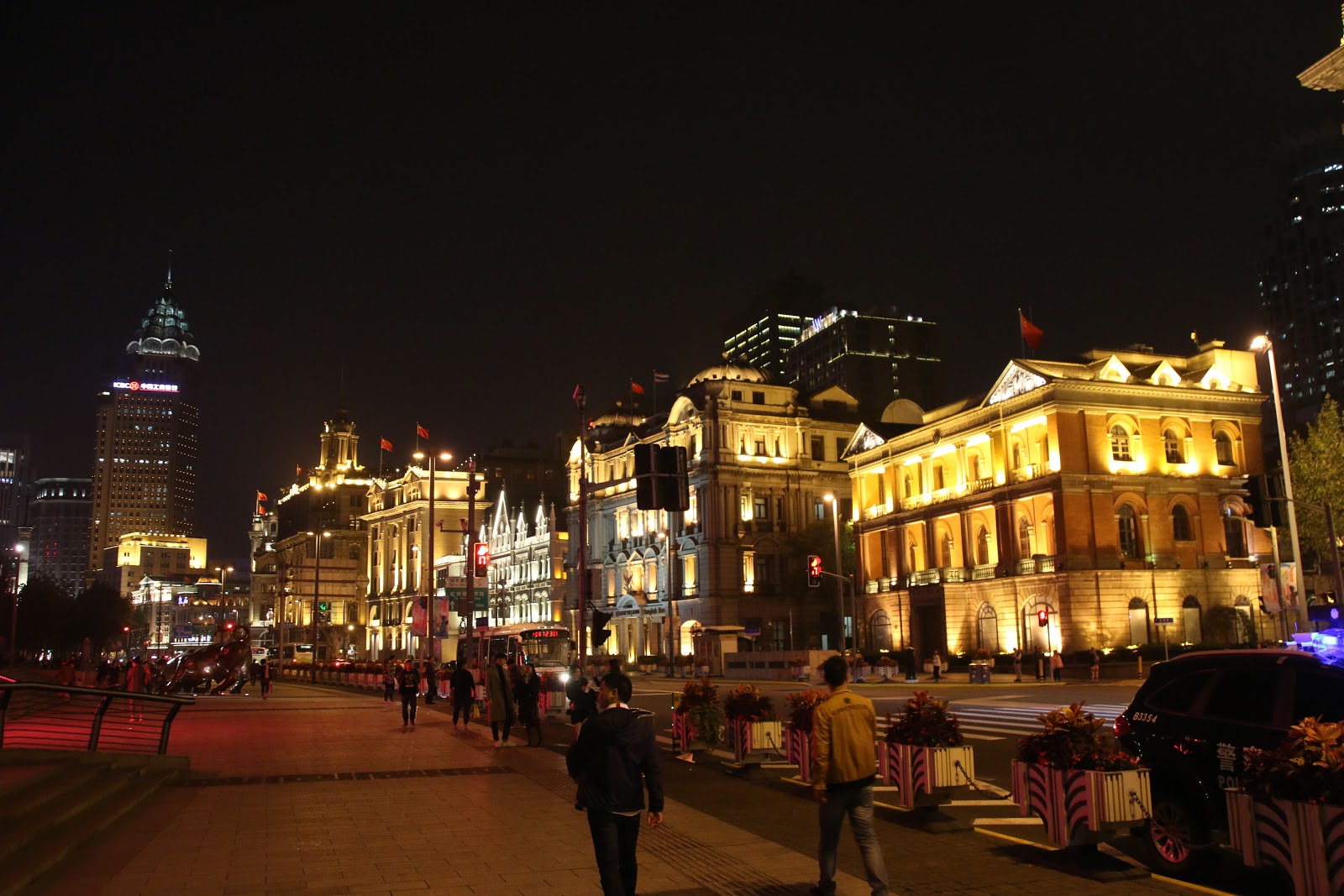
As Nick was seemingly getting delayed at the airport, I decided to go and check out the Bund, while waiting for him. The view from the Bund towards the financial district is pretty amazing, especially as it gets dark, and the impressive skyscrapers get lit up, one more spectacular than the next one. What was also pretty impressive was the huge crowds checking out the spectacle... Welcome to China...

The historic buildings on the Bund look pretty cool as well, lit up. I gaped at two of the more impressive buildings, including the HSBC bank (dating back to 1923, and no longer operated by HSBC) and the Custom's house (from 1927, with its clock and bell being replicas of Big Ben, made in England).

After a bit of hassle, I was eventually able to meet up with Nick. After grabbing a quick dinner (some very reasonably priced Shanghai-style dumplings), we decided to head and check out the financial district, known as Pudong, located just across the river from the Bund. It's certainly a very impressive area, with modern architecture every bit as impressive as one can find in say Singapore or Tokyo.

We figured the best way to get in a nice view would be to have a drink in one of those big buildings - so we decided to head for the Shanghai World Financial Centre - which houses a Grand Hyatt Hotel with a fancy bar on one of the top floors. The building measures a rather impressive 492 meters, making it the 8th tallest building in the world currently. The view from the bar was, needless to say, very impressive indeed, and the beer was actually cheaper than expected!

After a couple of drinks, we headed back to our respective hotels, determined to explore more of Shanghai the next morning, before carrying on to Hangzhou. In the end, it wasn't to be, as the famous Shanghai smog was well and truly present in the morning, limiting visibility to about 10 meters maximum. (just have a look at this picture from the Bund, and contrast it with pictures I took the day before...).

So, after a short but intensive stay in Shanghai, we jumped on the high-speed train to Hangzhou.