Sunday, September 25, 2016

Exploring Lantau island

Our good friends Raphaelle and Olivier recently moved to Hong Kong. In addition to that, Mathilde's cousin Emeric (whose wedding we attended just before starting our Asian adventure) also lives in HK. So, it was pretty obvious that a visit there was on the cards.... Since we have a one week break in our language school schedule, it was a good time slot to go for it.

Our flight to HK went smoothly enough. We took a bus from the airport to Raphaelle and Olivier's flat, which was located in Discovery Bay (aka. DB to locals), actually on the same island (Lantau) as the airport. A short hike uphill led us up to the wonderful flat (the view from their balcony really is impressive - and gives immediate proof for the fact that HK is much more than just highrise buildings).

We immediately headed off to explore the island. Lantau is actually a quite undeveloped island (although that is apparently about to change...), with plenty of hiking trails to explore. Discovery Bay is a bit of an expat enclave, very few locals to be seen (unless you count the mostly Philippine maids who live on the island). Anyway, we had quite a nice introductory walk around DB - I even made it up to a Trappist monastery! (which was closed, unfortunately)

We finished in DB for a couple of well-deserved drinks, followed by a rather non-Chinese dinner in an expat restaurant. It was kind of a nice change to actually have non-Asian food for a change (after two months of pretty much exclusively Japanese food).

The next day, it was time to head off for some serious exploration. Our first stop was at Tai O, a rather curious Chinese fisherman village located on Lantau. It's very Chinese and very authentic indeed, with wooden houses built on wooden poles, and some real fisherman actually seem to live there as well (judging from all the fish drying outside the houses, and the smell of fish that prevails). Definitely not what I expected to see in Hong Kong!
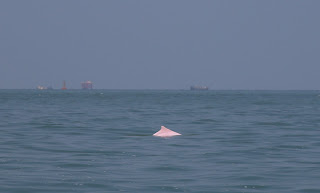
One of the touristy things to do in Tao O is to take a boat tour around the village and out in the sea as well, in the hopes of spotting some dolphins. Cynical as we were, we didn't expect to see any dolphins, so imagine our surprise when we saw not only one, but several dolphins. And our surprise was even greater when we realized they were pink!  We were also treated to the impressive sight of the ongoing construction of what will be the longest bridge in the world (a bridge that will connect Hong Kong to nearby Macau).

The boat tour done, we had a walk around Tao, very much enjoying it. It's a very buzzing place, with loads of busy shops lining up the roads (selling mostly dried fish, which didn't really tempt us, to be honest). It was very touristy in a certain way, but since nearly all of the tourists were Chinese, it didn't actually feel that touristy, somehow. The plan was to have some local Chinese food, but we found a lovely place located by the water, with great views over the village, that we decided to lunch there, even though they only served pizza (and the pizza wasn't all that good, to be honest).

Chinese fishing village ticket off the bucket list, we carried on to check out THE major tourist attraction on Lantau, the Big Buddha. The Buddha, sitting on a hilltop, watching over the surrounding lush countryside (including the majestic Po Lin monastery), measures an impressive 34 meters. It's not actually a historic attraction as such, as construction of the statue was completed in 1993! (it took 12 years to complete).

Before walking up the 286 steps up to the Big Buddha, we decided to visit the aforementioned Po Lin monastery. It was a pretty impressive place, even if a bit overran by tourists (like us). The monastery dates back to 1906 (it seems older than that). The big hall housing loads of Buddha statues behind the main temple was particularly impressive. We were also treated to the spectacle of some monks chanting in the main temple building... Before tackling the Big Buddha, we decided to have a few refreshments and sweets at the temple's veggie restaurant.

We then walked up to the Big Buddha. The views from up there were predictably stunning, especially since we were lucky enough to have sunny weather. After enjoying the views for a bit, we made our way towards the cable car station, checking out a rather uninteresting street full of tourist trinket shops.

So far, we've very much enjoyed Hong Kong, even if what we have seen so far (nature, a fisherman village, a Big Buddha statue) doesn't really correspond to our image of HK!

Friday, September 23, 2016

A quiet week in Tokyo

The last week or so has been extremely busy, with a sumo tournament, some Iaido, a trip to Kyoto as well as my brother and Katja visiting (not to mention attending intensive Japanese courses). Not that I'm complaining or anything.... So, since the weather was pretty bad to boot, and we had a trip to Hong Kong to look forward to, we had a rather quiet week for a change. We did get up to a few things, though.

One place we really enjoyed visiting last year was Mitaka, a small town located at the Western outskirts of Tokyo, famous due to the fact that the Ghibli museum is located there (we visited it last year). So we decided to visit it on a not-so-rainy Wednesday, before our Japanese course. The idea was to try to relocate a nice area near the train station, where we had checked out quite a few nice, quirky shops. However, we struggled a bit to find the place. We got diverted (my fault!) into visiting a couple of modestly interesting temples (let's say they didn't overly impress as after a weekend in Kyoto...).

We then walked through the rather nice Inokashira park (where the Ghibli museum is located), after which we realized it was time for lunch. We found a rather nice restaurant specializing in beef tongue - very tasty indeed! That's the cool thing about Japan, and Tokyo in particular, there are just so many restaurants to discover, a lot of them specializing in very specific types of dishes. A pity we're not good enough at reading Japanese to identify just what each restaurant specializes in!

Thursday night, we decided to head into Asakusa for a nice evening walk, and a bit of shopping. Asakusa is one of my favorite parts of Tokyo, as it's one of the areas of Tokyo that still has a bit of that "Shitamachi" atmosphere. Shitamachi is a term used to describe the area roughly speaking east of the imperial palace - it's where the lower social classes used to live (the rich folks lived in the hillier Yamanote, west of the imperial palace).

As Asakusa has mostly been spared of most modern developments, the place s very different indeed from ultramodern parts of Tokyo like Shibuya, Shinjuku & Roppongi. Anyway, we enjoyed a rather nice evening walk along the Sumida river. We also visited the Asakusa tourist information center (Asakusa caters to a lot of tourists since there's also quite a lot of cheap accomodation there). It's a pretty cool place actually, with  some exhibitions about Asakusa, and best of all, a panoramic terrace from where there are quite nice views over Asakusa and the Sensoji temple (a shame I didn't bring my camera - my smartphone is not particularly good for low-light photography).


On Friday night, we decided  to head for dinner with  our culinary guide Matsuoka-san. As always, we had a fantastic tim. He took us to another place that would basically be almost impossible to find by just strolling around randomly (the place is discretely hidden on the second floor of a building near the train station). The food was of course great, as always. They had "erotic sake" on the menu, which we just had to try (there was some French writing on the bottle - not sure whether that's what made it "erotic"?). We also tried some sparkling sake, which I didn't even know existed. 

Sunday, September 18, 2016

Weekend in Kyoto

We've visited Kyoto twice so far already, and were surprised to find ourselves a bit underwhelmed on both occasions. The first time around, we were too much in a hurry to see the most famous temples (which were very impressive indeed, don't get me wrong) to really have the time to walk around and get a feel of Kyoto. And the 2nd time around, we only had about a day in Kyoto, which we spent mostly in the hypercentre, near the train station (which isn't really the most interesting part of Kyoto -as it's quite modern). So we were quite looking forward to joining Katja and Janne in Kyoto for a 3rd visit. This time around, we were hoping to get to spend a bit more time walking around.

Unfortunately, Janne and Katja were not feeling too good, so it ended up being a bit of a solo visit. We started off by catching a local bus to our AirBnb (hotels were ridiculously expensive, probably due to a national holiday on Monday, so we decided to go for Airbnb this time around), a bit outside the town center, but located near one of the temples we wanted to visit, Ginkakuji (aka the Silver Pavilion). Nobody seemed to be home at our flat (which was attached to a Spanish restaurant), so we decided to head off and visit the temple, and come back later.

Ginkakuji is one of the most famous temples in Kyoto (which is to say it's one of the most famous ones in Japan). Its construction was ordered by the Shogun Ashikaga Yoshimasa in 1460 - the place was supposed to be a place of peace and reflection for him, and then become a Buddhist temple upon his death. Apparently it was a very restful place indeed, since Yoshimasa spent the rather nasty Onin wars (during which Kyoto was pretty much all burnt to the ground) contemplating the beautiful gardens at Ginkakuji.

Mind you, can't blame him, the temple, and in particular the gardens, are about as perfect and harmonious as only a Japanese  temple can be. Ginkakuji may be a bit less impressive than Kinakuji (the Golden Pavillion), since the restored pavilion itself is lacking the original silver color - but the place is still a pretty perfect example of a Japanese temple.


Our minds soothed by the beauty of Ginkaku-ji, we headed off for lunch. One of our Japanese teachers had recommended a good Udon noodle place near Ginkakuji, which we were able to locate. Excellent recommendation, the food was really good. After lunch, we dropped our bags off at the flat, and then continued our exploration of Kyoto.

We decided to walk down the so called Philosopher's Way, a pedestrian route following a canal, which goes past quite a few famous temples. (it starts near Ginkakuji). Along this lovely footpath, one really starts to get the feel of old Kyoto, with the old traditional wooden houses lining up the streets, and the beautiful temples fusing into the surrounding nature.

We stopped by at Honen-in, one of the less famous temples in Kyoto. Yet it's also a sublime place, so calm and harmonious in the middle of nature. What's so fascinating about the temples of Kyoto is that they are really all very different - and Honen-in for example is very different from Ginkaku-ji. Apparently the place is particularly beautiful a bit later on, in October/November, when the arrival of autumn turns the leaves red and yellow.

Our next stop was (of course) yet another tempe, Eikan-do. Again, a sublime place, with both very interesting temple buildings and some stunning gardens. It's a very venerable institution, dating back to the 9th century. The present structure dates back to the 16th century (the temple was destroyed during the aforementioned Onin wars). The temple grounds are very extensive, so we took quite a lot of time to explore it all.

We were starting to suffer from the Temple Overload Syndrome, which happens very easily in Kyoto (similar to the Church Overload Syndrome one can suffer from in Florence), but we decided to bravely push on to Nanzen-ji anyway. Nanzen-ji is one of the most famous temples in Kyoto, belonging to the Zen Buddhist sect. We contented ourselves with just visiting the temple grounds this time, rather than paying the entrance fee (due to aforementioned temple overload syndrome). We were less impressed with this temple than the other ones we'd seen (probably our opinion would be different if we'd have paid the entrance fee), but the impressive Sanmon port is a sight to behold, to be sure!

By now we'd seen enough temples (and anyway, it was getting quite close, so they were all shut anyway), so we decided to head to Gion and towards the town center. Our walk (which again took us through some really beautiful streets that give a pretty good idea about how Japan was like during the Edo Period) took us through the famous Yasaka-jinja, a famous Shintoist shrine, one of the most important ones in Kyoto. It protects and overlooks Gion, the famous entertainment district of Kyoto, home of the famous Japanese geisha.

We then walked on into Gion, which is still quite a fascinating place to visit, even though it has sadly become very touristy. There are still streets that evoke old Kyoto - and on a lucky day, one can even spot a real Geisha (rather than one of the many fake ones, most from Korea apparently??). I believe we spotted a Maiko (apprentice geisha), who was rushing down a busy street (trying to avoid the masses of tourists trying to take a picture of her).

We then started a rather long search for a restaurant in Kyoto. One would imagine that finding a good restaurant in Japan is about as difficult as finding a pub in Dublin, but the fact that most restaurants only have menus in Japanese does make the task a bit daunting sometimes. We eventually found a nice place serving soba noodles. After dinner, we were really knackered after all that walking, so decided to head back to our room to get some sleep. Still, in spite of our fatigue, we were very happy with our day in Kyoto - I really felt like I had finally discovered that "old Japan" that's quite hard to find these days here in Kyoto .

After a really good night's sleep, we got up and headed off to explore Kyoto again. We didn't have much of a plan, and had some logistical issues to deal with as we had to put our bags in lockers at the train station, and also a rather menacing weather forecast to look forward to. Anyway, we managed to eventually find lockers for our bags (not an easy task due to the public holiday coming up), and headed off to continue our exploration of Kyoto. We started, kind of randomly, with Sanjusangen-do, just since we happened to walk past it.

Turns out it's one of the most stunning temples I've ever seen. Well, the temple itself is not actually all that special. But the main building houses a hall, which houses 1001 rather stunning Kannon statues dating back to the 12th and 13th centuries. Since we had no idea what to expect, the sight of all those statues really blew our minds away. I was really gutted photography was forbidden, so no pictures of the stunning main hall, I'm afraid... But anyway, this temple yet again demonstrates the diversity of the sites in Kyoto, yet another temple that's totally different from the ones we'd visited the day before.

We spent the next couple of days to explore the area south of where we'd been the day before, walking in some of the most well-preserved parts of Kyoto. The more I walked around, the more I digged Kyoto. I had truly found the Japan I've read about in Clavell's shogun, the one inhabited by heroic samurais, mighty castles and stunning temples. OK, not that many samurais around anymore, but you get the point. We checked out a couple of other nice temples, Kodai-ji and Kennin-ji. We didn't pay the entrance fee in either case, so probably didn't see the most impressive parts of the temples. Our quota of temples was kind of full for this visit.

Unfortunately, Katja and Janne were still immobilized by a nasty stomach bug, so we only saw them in their Airbnb flat. Thankfully, they got better after we left, so were still able to appreciate Kyoto, as we had done. Our visit was over as well, as it was time to catch our train back to Tokyo (good timing, in the sense that the forecast rain started pouring down).

So, our impressions of Kyoto, then? As I guess you'll have guesses, I really love the place. It definitely merits further exploration! So until next time...

Thursday, September 15, 2016

Iaido - the art of cutting with a Katana

Now, as a kid, I loved Japan. Mostly because of samurais and their powerful Katanas. Now, the reasons for me liking Japan have evolved a bit since then, but there is still something essentially very Japanese about samurais and katanas. Samurais, and the codes they live by, still resonate in Japan today, and many of the old codes and rules of conduct still apply in today's Japan (or should, at least). The katana is also somehow symbolic of Japan's constant strive for perfection.

So, when I saw an activity called "Iaido - Japanese sword experience" in our language school's event calendar, I immediately signed up. When signing up, I sort of figured we'd get to play around with wooden swords and maybe see a katana, and if we were lucky, see a pro wield one. So imagine my excitement, when I realized that we were to actually get to use one!

OK, we started off with practicing with wooden swords (fair enough, really). Which was already quite good fun, especially as we were taught by the dojo's grand master. Then, after about 2 hours of practice with the wooden swords (practicing just one cut, the easiest one, obviously, cutting almost vertically down from holding the sword over ones head), we got the real katana.

The plan was simple enough, cut down on a rolled tatami mat, and cut it cleanly in two (this is the reason the cut is actually sort of diagonal rather than vertical, as the rolled tatami mat stands vertical).  Easier said than done, as the cut still needs to be reasonably accurate, and straight, for the tatami mat to be cut cleanly in too. A lot of zen Buddhism was invoked as well, about emptying the mind before "cutting".

Anyway, I got three attempts at my mighty enemy the tatami mat. The first one sort of half failed (meaning I hit the rolled-up tatami map but didn't cut it cleanly in half). The 2nd attempt was much better, I managed to hit the tatami mat more or less where I wanted, at the right angle, so the tatami bundle was indeed cut in half cleanly. A feeling of calm and relief overcame me... The third attempt was OK, but not as good as my 2nd cut.

At the end, the masters showed how the tatami mat cutting should REALLY be done, demonstrating some pretty impressive combinations. All in all, a fantastic experience - a great way to spend 3 hours really! 

Wednesday, September 14, 2016

Janne and Katja visiting Tokyo

We were very happy to welcome my brother Janne and his girlfriend Katja in Tokyo - they were visiting Japan for 2 weeks. Their travel plan was a bit unusual in that their flight landed in Fukuoka (located on the island of Kyushu), from where they took the legendary Shinkansen down to Tokyo (passing by Osaka, where they spend the night).

We decided to meet for dinner in Ueno on their first night, which is where their hotel was located. After some searching around (finding the restaurant serving just the kind of food one wants is not always an easy task!), we eventually found a nice-seeming restaurant not to far from the train station, just of Ameya Yokocho (a busy shopping street in Ueno). Actually, the main reason we picked the place was the English language menu. The food wasn't all that great, in the end...

The next day, before meeting Janne & Katja, we were finally going to see a Sumo wrestling tournament! We've wanted to go to one each time we came to Japan, but they only take place on odd months and as it happens, we've always visited on even months... Until now! This time we managed to get tickets!

So off we headed to the legendary Ryogoku Kokugikan - the sumo stadium located in Ryogoku (not far from Asakusa).

Sumo wrestling is, of course, one of the most popular and traditional sports in Japan. The origins of sumo go back centuries - the sport became professional during the Edo era (so during the 19th century). Of course it's about as Japanese as a sport can get, so it's quite ironic then that the 4 current Grand Masters all come from Mongolia. Unfortunately, only 3 of them were participating today (the others were injured). There is actually a sumo museum at the Kokugikan which I suppose tells more about the history of the sport, but we didn't have time to visit it this time around...

The proceedings started about 3 o'clock, but we only joined around 4:30 (with Matsuoka and his son, who joined us), since the better matches are towards the end of the day (with the grand master having his match last). It was just about as mythical and exciting as I expected. There is a lot of ceremony involved - the ceremonies and build up lasts for a few minutes, whereas the actual match often only lasts for a few seconds (but those seconds do tend to be very intensive indeed). The subtleties of the sport were clearly lost to us, but to summarize, the grand master was defeated in the last match - a big upset!

After the sumo tournament, we joined Janne and Katja for dinner in Akihabara, our restaurant guide Matsuoka had picked a nice Izakaya for the occasion. The quality of the food and drink was, as expected, perfect. And nice to be able to show a proper Izakaya to Janne and Katja as well - visiting a proper Izakaya is of course a mandatory experience during a trip to Japan!

The next day, we were meeting Janne and Katja for lunch at one of our favourite restaurants at Tokyo - the Tofuya. We discovered this wonderful place during our trip to Japan last year. Basically, they've disassembled a sake brewery from the Japanese countryside, and planted it in the middle of Tokyo (just by Tokyo Tower). The rooms are all traditionally Japanese (think tatami mats), the service is impeccable (think Ryokan), the food, crafted around tofu, is delicious (think kaiseki). There is even a beautiful Japanese garden in the middle of the place, which can be seen from the dining rooms. Anyways, the food was just as wonderful this time as last time around, oishikatta desu as the Japanese would say!

After lunch, we sped down to Iidabashi for our courses, after which we headed over to Asakusa where we were meeting Janne and Katja again. After checking out our favourite Tokyo temple, Sensoji (unfortunately it was shut when we arrived, but it does still look very evocative, lit up in red as it is after sunset), we headed off to dine. This time we tried Okonomiyaki, kind of Japanese pancakes/omelettes (actually Okonomi means "whatever you want" in Japanese, so basically the ingredients of an Okonomiyaki are very diverse).


Sunday, September 11, 2016

A busy weekend around Tokyo

Upon arriving in Japan, we somehow figured we would have time to do everything we wanted. But alas, as reality is starting to kick in, we realized that we don't actually have that many weekends in Japan (especially as we are planning a weed in Hong Kong), so best make the best of them!

One of the places we loved visiting on our first visit to Japan was Kamakura. As it's easily done as a day trip from Tokyo, we decided to head there on Saturday. Although, actually, we ended up catching a train to the island of Enoshima from Kamakura upon arrival - Enoshima had been recommended to us by one of our teachers.

The train station took us to Fuhiwara, a small town which is connected to Enoshima by means of a bridge. We marched straight across to Enoshima, eager to explore. But first thing is first - we were hungry - and those street stands selling fried cuttlefish just looked to enticing, so we decided to have one of them for an early lunch.

The main reason to go to Enoshima is to visit the Enoshima shrine - of course, this is after all Japan! (well, the main reason might actually be to go to the beach, but the beaches are on the mainland side). The shrine (which is composed of quite a few building scattered on a grassy hilltop, only accessible on foot) is dedicated to the goddess of good fortune, Benten, who according to local legend created Enoshima after subduing a 5-headed dragon!

We joined the crowds (I suppose we weren't the only ones who wanted to make the best of the sunny weather...),and hiked up to explore the shrine, which was picturesque (of course!). There were some pretty nice views towards the mainland coastline and the surrounding sea as well from various well signposted viewpoints (where they even had the courtesy to place small stands where one could place ones camera to take that perfect selfie - they really think about everything, those Japanese!)

The best view was to be had from the Sea Candle (a 60 meter tall observation tower, located at the highest point of the island, in Samuel Cocking Garden) - which we checked out, of course. Apparently, on a bright day, one can see Mount Fuji, but alas, in spite of the sun being out, the sky just wasn't bright enough, apparently... But the views were nice, anyways.

We then carried on walking around, finishing at the southern tip of the island, where the coastline just looks stunning. We were tempted to just go and lie down on the flat rockbeds found just beneath the footpaths, as many people were doing, but decided to first check out the famous Iwaya caves. There are two caves to explore - the first contains a collection of buddha statues (not quite sure how they ended up in there?) whereas the second one is dedicated to the mysterious 5-headed dragon mentioned earlier in the post.

We then spent a fair bit of time just lying down on the rockbed, enjoying the stunning view, the sea, and the beautiful sunshine... Also, we were quite simply rather nackered after all the walking about... Anyway, eventually, it was time to get off our bums, and head off back towards the mainland. After all, we still had Kamakura to visit! It quickly became obvious we would need to be very selective about what to do in Kamakura, as it was past 3 o'clock...

Kamakura played a very important role in Japanese history, as Japan was ruled from here for over 100 years (the Kamakura Shogunate was established here in 1192 by Minamoto Yorimoto). So there is obviously a lot to see - as is often the case in Japan, mainly temples and shrines.

The main sight to see here is probably the Daibutsu - big Buddha - the second biggest in Japan. So in spite of us having already seen it during our first trip to Japan with our good friend Andy, we decided to check it out again, mainly since it was close to one of the train stations conveniently located on the way into Kamakura from Enoshima. The impressive statue was made in 1252, and measures an impressive 13 meters in height. Even today, it's a sight to behold. Unfortunately, we arrived a bit late, so couldn't visit the inside of the statue.

The plan was then to check out Hase-Dera, a temple near the train station, and then head for dinner. Unfortunately, we were too late, though, the temple was closed... There were some nice Japanese ladies who left the temples wearing traditional kimonos, which made for a very nice photo ;)

Time for dinner then! We jumped on the train back to Kamakura, where we started looking for a restaurant in one of the main shopping streets (Komachi Street) near the train station. I was rather keen to try shirashi, which is the local culinary speciality in Kamakura and Enoshima. Shirashi is basically raw baby sardines, usually eaten with a bowl of rice. Pretty much every restaurant in Kamakura serves them, so we needn't have worried. We both had set menus that included this little delicacy - and we did indeed enjoy the shirashi!

The next day, the weather forecast promised rain, so we decided to check out a museum. But before that - SPORT! We decided to go to the local swimming pool. But actually, we stumbled upon the Kitasenju matsuri before that, so things got a bit delayed as we checked out the local festivities. It as all pretty cool in a very family-friendly way.

There were floats (wagons carrying musicians playing various instruments), Mikoshis being carried around (like we had done just 2 days ago - a fact my shoulders could still feel very vividly!). There was even a small mikoshi being carried around by kids. All good fun!

We decided to check out the Tokyo National Musuem, the granddaddy of Japanese museums. It's quite conveniently located in Ueno, which is not far from Kitasenju, so we jumped on the Metro and headed down to Ueno.

First thing was first - lunch. We ended up in Wendy's of all places! Big mistakes - the burger I ordered looked nothing like the picture, and Mathilde's meal was quite a letdown too. That figures, eating American food in Japan...

Tokyo National museum is located in Ueno Park, which is a very nice place to stroll around, so we did that to start with, checking out the street performers for a bit, and a troupe that was practicing their number for some Tokyo Olympics 2020-related big event that was being held in the park.

The museum, then. It's a pretty big place! This huge place, the oldest museum in Japan (opened in 1872), takes several visits to fully explore, I reckon. There are 5 or 6 buildings to explore, each with a dedicated theme. We started with the Honkan (which is the original museum building), or Japanese gallery.  The place, as the name suggests, traces Japanese arts in its various forms. Part of the exhibition tackles the art forms one by one, and part of the exhibition takes a historic time line approach. All in all, interesting stuff. I naturally preferred the samurai weapons and armor, goes without saying...

We then checked out one of the other buildings, which contains a huge collection of items from Horyu-ji (a famous temple from Ikaruga in Nara prefecture). There was a quite impressive collection of Buddha statues, but to be honest, we did't stay for that long (huge collections of religious items can hold our interest for only so long...). The building itself, modern, is very nice, with its rectangular shapes, located next to a reflecting pool.

By now, Mathilde had had enough, so I continued to the Asian collection on my own. I had only about 40 minutes to check out all the art in there, which clearly isn't enough. (after all, there was China, Korea, South-East Asia, Egypt and the Middle-East to cover) But it was a nice introduction to Asian art, I suppose one could say. I probably preferred the collection of Chinese statues at the beginning of the exhibition.

Then, it was time to call it a day. After all, we had to get a bit of rest before what was promising to be a busy week: Janne & Katja visiting Tokyo, attending a sumo tournament, Japanese sword cutting, and finally a trip to Kyoto!

Friday, September 9, 2016

Matsuri in Iidabashi

Japanese summer is typically not the best time to visit Japan, as the weather is quite heavy and humid. However, one great thing about the summer period in Japan are the Matsuris. A matsuri  is basically a local festival associated with a shrine (quick note here, temples in Japan are buddhist, shrines are Shintoist). Typically, in a matsuri, the kami (spirit) associated with a shrines is carried around the local neighborhood in a so called Mikoshi (a heavily ornamental box with a wooden frame which allows it to be carried around).

Now, typically, local businesses pay to participate in the matsuri, which means the businesses employees can dress up in traditional dress and carry around the Mikoshi. We were lucky enough that our language school (Cote Language Academy) was participating in the Iidabashi matsuri, me and Mathilde were very curious about the whole thing so decided to sign up.

So, basically, we dressed up in Happis (a robe like vest worn by the Mikoshi teams), and joined the fun. Basically, carrying the Mikoshi is great fun, but boy it's hard work, too! The thing weighs about 1000 kg (the one for women was lighter...), so carrying it around for 2 hours is definitely hard work! Actually being tall like me kind of makes it harded, as the weight tends to be on your shoulders, unless you crouch ;) (which I did, but that's not very comfortable either). But anyway, the atmosphere is great, and boy do you feel you deserve that beer they serve afterwards ;)

The whole thing lasted about 3 hours - of course we didn't carry the Mikoshi all the time (there were about 200-300 people participating altogether - and of course a particular company's Mikoshi crew will tend to carry the Mikoshi when the circuit approaches their particular company's office). The event was a great way to get to know some of the other students, and teachers, at the academy, too. (usually it's just me and Mathilde in our course, which is great in terms of learning Japanese, but not so great for socializing).

All in all, it was very much an unforgettable experience! (my shoulders certainly still remember the event!)