Tuesday, October 11, 2016

Kabuki time

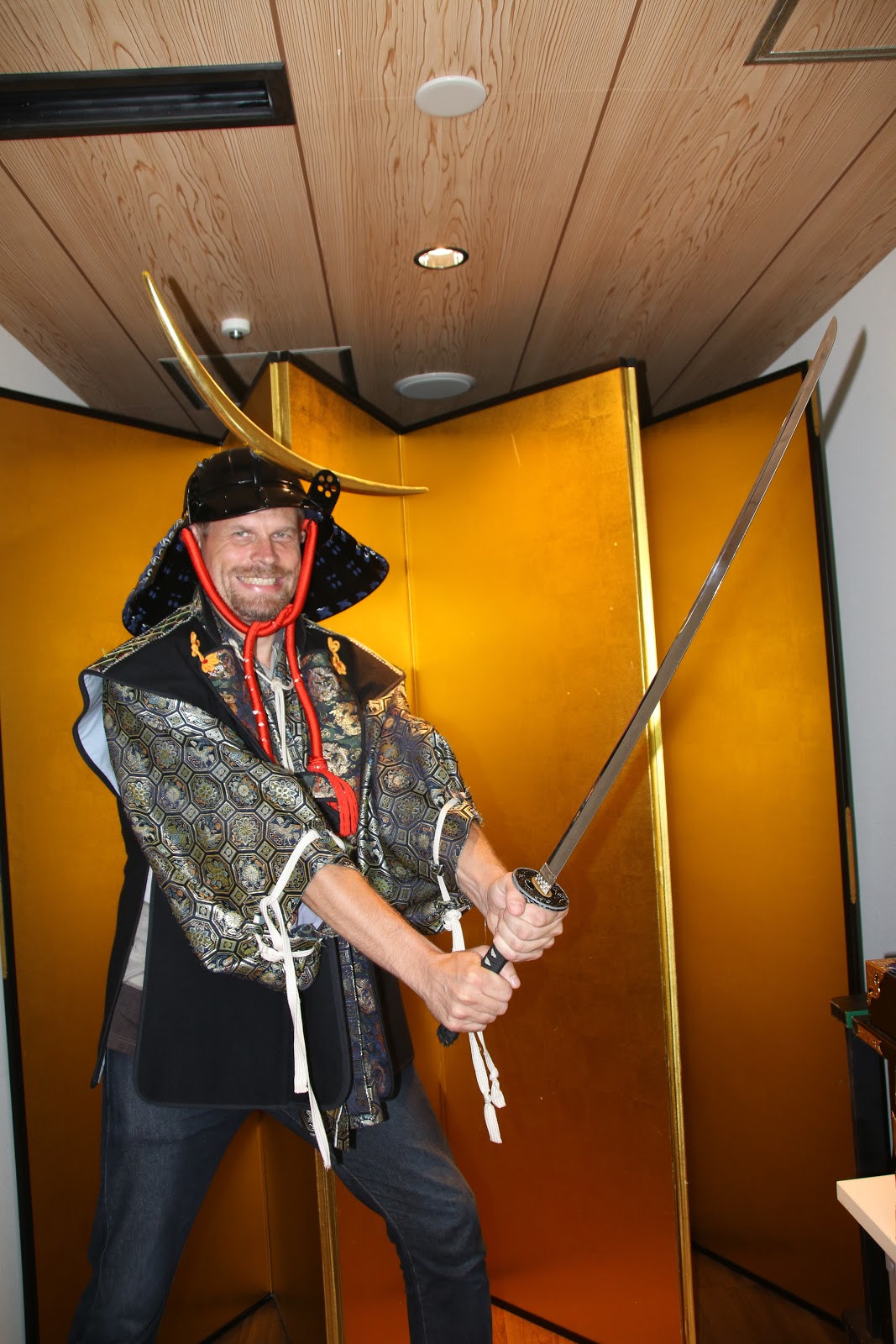
We have a kind of bucket list for things we want to do in Japan. I've crossed off a couple (watched a sumo tournament, wielded a Katana) during this trip, but a few remain (I want to eat Fugu, climb up mount Fuji, watch a kabuki, for example). The kabuki one is easy to cross off the list, so we decided to go for it this Tuesday. Kabuki is, in case you didn't realize, dear reader, one of the two most famous types of traditional Japanese theater (No is the other one, and apparently it's more difficult than Kabuki)

So off we headed to Ginza, where the legendary Kabuki-za is located (or rather, the latest of many incarnations, this one is only a few years old, even if it looks like a historical building from the outside). We weren't really mentally (nor financially) prepared to take on a full 5-hour kabuki play, so decided to rather go for single act tickets. For this, you have to show up an hour before the play starts, and queue. Actually, we got tickets for the two first acts, in the end...

The first act was all about dancing, and only lasted about 20 minutes. But it was all very beautiful (the costumes, the music, the dancing, everything basically). The second act was proper kabuki (although apparently the play was a bit of a satirical take on a very famous kabuki play). We decided to get a "visual guide" (which basically translates all the dialog for you, and describes the action, on a tablet-like device). Which was an excellent call, as we would've been completely lost without the guide (indeed, our Japanese is certainly not up to scratch to follow a kabuki act, I'm afraid...). With the guide, it was a pretty interesting experience.

The story was basically about the first shogun of the Kamakura Shogunate, after defeating the rival clan in battle, then decides to wear the emperors dress. This shocks both his opponents, as well as the hero of the story, who challenges the future shogun. (the twist of the story is that the hero of the story is a woman, rather than a man - played by an actor specializing in female roles).

An interesting cultural experience then, one that I can warmly recommend (do go for a single act ticket though, and remember to get the translation unit!).

Sunday, October 9, 2016

A busy weekend in Tokyo

Second last weekend in Tokyo, snif... What to do. Plenty to do, so little time... Friday evening, we decided to not get too ambitious, and sort of randomly decided to go to Ikebukuro after our Japanese class.

Upon arrival, we (again, rather randomly) decided to check out Nekubukero - which is the oldest "cat petting zoo" in Tokyo. What's a cat petting zoo, you ask ? Well, something that probably only exists in Japan. It's basically a kind of "cat house" (located on the top floor of the Tokyu Hands department store), where people (usually teenage girls who don't have cats at home, I suppose) can go and, well, play with cats and watch them live in their "cat kitchen", and so forth. It's all very Japanese, and a bit weird. Oh well, one more experience to tick off the bucket list, eh ;)

The next day, we decided to get a bit more ambitious and visit Odaiba -  a part of Tokyo we've not visited yet. Odaiba is a huge entertainment and shopping district located on an artificial island, in the bay of Tokyo. Construction here started during the economic boom of the 1980's, but alas, slowed down when the bubble burst in the 90's. Since then, construction picked up again, and it's now a pretty cool part of Tokyo to visit, with things to do for everybody.

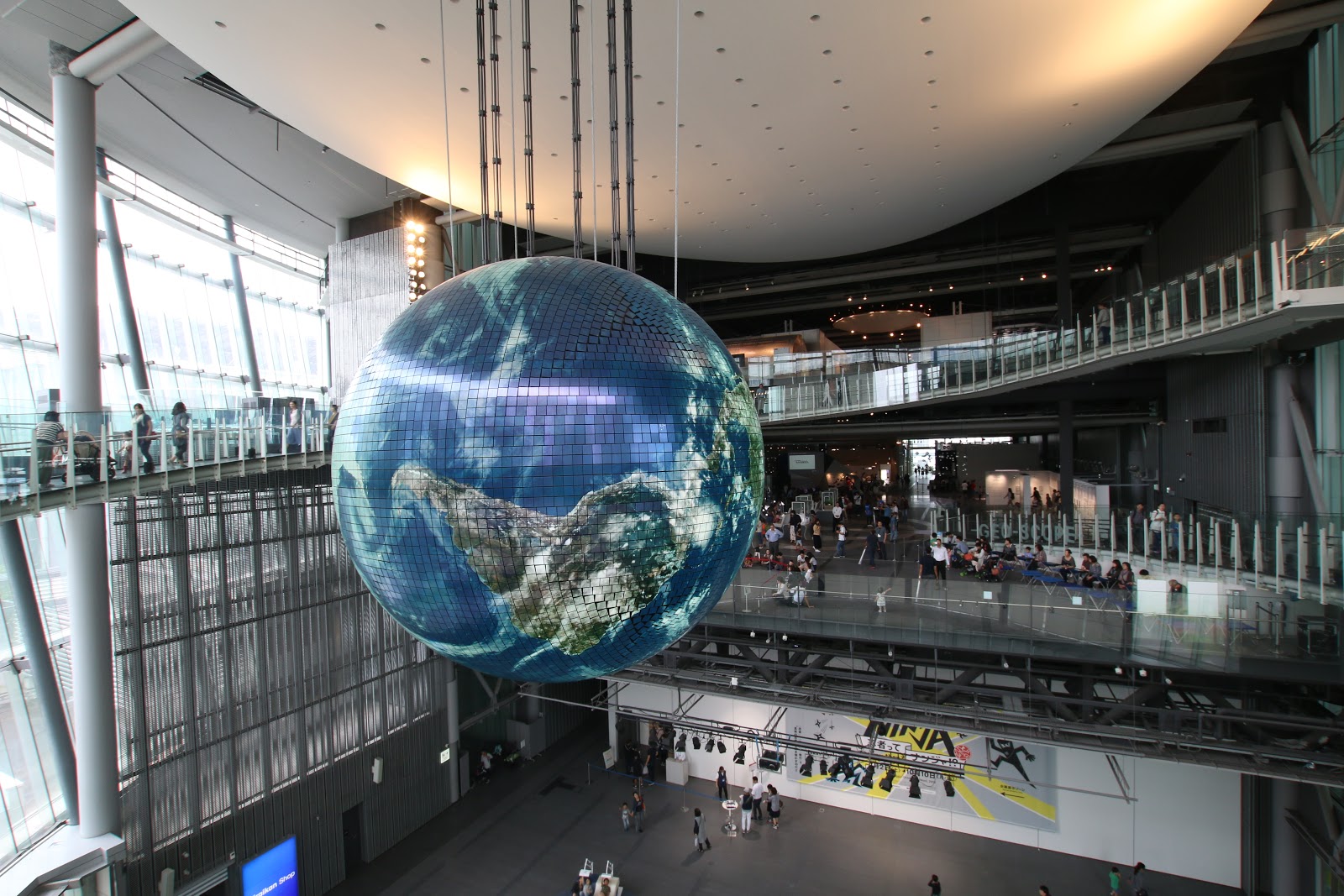
We started our exploration with the National Museum of Emerging Science (or Miraikan - which means building of future in Japanese). I've wanted to check out this place for a while... The main draw of the place is probably their robots, they have quite a few on display, some of which one can actually interact with. Mathilde had a rather surreal (and one-sided, with the 'bots doing most of the talking) discussion with three robots about the future of healthcare...

The main draw of the museum is no doubt the Asimo humanoid robot. The white plastic chap was indeed rather impressive, walking around the scene in front of everybody, walking forward, backwards, side ways, waving his hands, and even kicking a ball. The movement was, for sure, smooth and almost human-like. But, there is no interaction as such, so I think we are quite some time from having "thinking robots" yet (fortunately!?)

Apart from that, the museum was a bit disappointing, actually. There wasn't all that much informative displays about other technology that will impact our future - this being a museum in Tokyo, Japan, I somehow expected more. There was a pretty coo Ninja exhibition at the bottom floor, though, which I really enjoyed. The architecture of the building itself is really cool though - and it definitely embodies the future, as it should do...

We then carried on to Venus Fort, a big shopping centre. On the way there, we ended up at Toyota Historic Garage (an extension of nearby Tokyo Mega Web, more about that later). It was actually a really cool place, showcasing classic cars throughout the 20th century, in a kind of fake-retro environment. There were not only Japanese cars, but also Chevys, a Mustang, a Ferrari, a Porche, just to mention a few cars... Really cool place, especially as it was free.

Venus Fort reminded us a bit of the Venetian Casino in Macau, with its fake Italian canals. As this place was a bit less-over the top than the Venetian, it was kind of less impressive. But the shops are actually places where us mortals can actually shop too... (the Venetian mostly features fashion shops like Gucci, Versace etc).

I left Mathilde in Venus Fort and headed off to briefly check out Toyota Mega Web, a pretty cool place Toyota uses to showcase their latest car models, as well as their upcoming technologies. These days it's of course all about electric/hybrid cars, improved safety (Toyota, like most car makers, seems confident they can prevent lethal accidents involving their new cars in the next 5-10 years or so...) and autonomous driving. There were plenty of cool simulators to try (unfortunately, with rather long queues, so I abstained...), and even a test track where the brave ones can try out various fancy cars.

We then made our way to the possibly fanciest shopping mall in Odaiba, DiverCity Tokyo Plaza. The coolest thing about the place is NO DOUBT the life-size Gundam robot standing guard over the place. Sugoi desu ne, as the Japanese would say. Believe it or not, we ended up in a Hello Kitty cafe for a bit of coffee & cake break. The place was just unbearably cute. Another one to tick off the bucket list, eh ? ;) I have to say though, there was a hefty price tag for all that Kawaii...

By now, it was getting dark, so it was time to find a place to eat. We had a walk around Odaiba for a bit more before that though, checking out the statue of liberty replica (not full-size, this one only stands at 12 meters), with the rainbow bridge (the bridge that connects Odaiba to the "mainland") and the Tokyo skyline completing the rather beautiful view!

For dinner, we ended up in a Hawaiian restaurant, imagine that! There are actually quite a lot of Hawaiian restaurants in Japan, as it's actually quite close to Japan, and a lot of Japanese go there on holidays. Good choice, in the end, the burgers were excellent!

The next day, we were feeling a bit less energetic, partly due to the fact that the morning was rather rainy (apparently the autumn this year has been one of the rainiest in recent history - bad luck for us!). But, nonetheless, we decided to venture out to check out Shinjuku Gyoen, a big public garden/park located in busy Shinjuku. Historically, the garden dates back to the Edo era, and it was actually used by the Imperial family for recreation and for entertaining guests during the early 20th century. It was completely destroyed during World War II, but was rebuilt afterwards as a public park.

It's a very nice place indeed, and gives nice respite from the hustle and bustle of Shinjuku (one of the busiest neighborhoods in Tokyo). It's not my favorite garden in Tokyo, I prefer for example Koishikawa Korakuen. Shinjuku Gyoen is more of a public park than a traditional Japanese garden, actually, although part of the park is landscaped in typical Japanese fashion. There is also an English garden (basically a lawn!) and a French garden. The highlight, though, is a beautiful Taiwanese pavilion.

After a rather expensive "cake and coffee break" in a cafe, we headed into Shinjuku, Mathilde to do a bit of shopping, and me to visit a museum. And not just any museum either - the samurai museum! It was a great little museum, featuring beautiful samurai armor and weaponry. A very knowledgeable young chap, who also spoke excellent English, took us around the place, explaining about the history of samurais in great detail. The cool bit was of course when we got to try on the armor and a katana (not a real one, though!)

Before heading back to Kitasenju, I had a quick peek at the famous Golden Gai area, which was on the way to the metro station from the museum. The Golden Gai is a small area of winding alleys, full of small bars and restaurants, where the salarymen come and "destress" after a hard day at the office. Most of the bars are tiny, most accommodating less than 10 people. For sure a place to explore night-time one of these days!

Sunday, October 2, 2016

A day in Ebisu

We'd loved our 1 week trip to Hong Kong, but were happy to be in Tokyo, which is starting to feel almost like home. The contrast to Hong Kong is striking - Tokyo may be one of the world's largest cities, but it still feels like quite a peaceful place to live. We are already dreading the not-too-distant moment in time when we will have to leave...

Anyway, in spite of being quite tired after our trip to Hong Kong, we decided to head off and explore Tokyo for a bit - after all, the sun was out, and as mentioned before, we had little time left in Tokyo. After doing some research in guidebooks and on the internet, we decided to explore Ebisu - a part of Tokyo we're not familiar with at all.

Ebisu, which was named after the Yebisu brewery that used to be located here (the brewery has now become a big shopping complex, there is still a museum dedicated to the historical brew there, though), is these days one of the trendiest parts of Tokyo. We started our tour at the Ebisu train station, vaguely following a walking tour we found on the internet, but mostly just walking around randomly. We could quite quickly confirm that it's rather trendy and "bobo" (a French term which I'm not sure is really translatable into English, look it up on the internet ;) ), and also that it's a very nice part of Tokyo (does that mean we are bobos?).


We enjoyed a very bobo lunch indeed (I had a veggie burger and a smoothie, would you believe it?), and then headed off to check out the rather cool Yebisu Garden Place. This is actually where the afore-mentioned beer brewery used to be located, it has since been converted into a very pleasant place, containing fancy restaurants (including a 3 Michelin Star place by Joel Rebouchon), shops, gardens, cafes and a photography museum (which we visited - very interesting place indeed!).


After randomly walking around, checking out the vibe of the 'hood, we ended up visiting the Old Asakura family house. This property, built in 1919, is a rare example of Taisho era architecture. Most of historic Tokyo was destroyed either in the Great Kanto earthquake of 1923, or during Allied bombings during WWII. This property is rather interesting in that it combines elements of traditional Japanese architecture, but with some Western influence (the early 20th century was a period during which Japan rapidly modernized, and took on western influence). The gardens around the house are also very beautiful. Certainly worth the 100 Yen entrance fee!

We then continued exploring bobo-land, checking out the trendy shops around the Daianyama area - we rather liked the nordic-seeming Log Road "shopping district", and in particular the wonderful Tsutaya book shop (this chain has a really working concept which basically combines a cafe with a great collection of books - one could easily spend a day in these places!)

We finished our exploration of Ebisu by having, believe it or not, pizza! Usually, we strive to have Japanese food in Japan, but we read about this place called Isa, which serves authentic Naples-style pizza. Somewhat skeptical, we still decided to go. Woe and behold, their pizza really was pretty damn good, and very much in the Naples style indeed. Apart from the fact that all the waiters and the chef were Japanese, one could almost have imagined having been in Italy. Apparently the chef had one some Pizza World Championship award in Italy - well deserved if you ask me! Mind you, the pizza was rather a lot more expensive than in Naples...

Saturday, October 1, 2016

Last days in Hong Kong

Coming back from Macau, we still had a couple of days left in Hong Kong. Actually, Mathilde's cousin Emeric, who's been living in HK for about five years, had invited us for dinner, so we headed straight from the ferry terminal to Kowloon, where we were meeting him.

Kowloon (the name comes from 9 dragons, referring to the 8 hilltops in Kowloon, as well as the 9th dragon, the emperor) is what could be called the "real Chinese Hong Kong". It's an impressive multi-ethnic mix featuring street markets, eateries of all sorts, fortune tellers, parks, a walled city, temples, and more and more modern constructions & impressive skyscrapers.

Emeric picked us up at the metro station, and took us to his flat, a traditional HK style apartment (to reuse a worn out phrase, straight out of a Wong-Kar Wai movie) he was sharing with his newly-wed wife (we attended the wedding just a couple of months ago in France!), who is a Hong Kong native. Emeric cooked up a very authentic hot pot meal (the idea is simple - just cook the ingredients you fancy in a big pot with a spicy sauce).

After dinner, we went out on a tour of the local neighborhood. A tour with a real local tour guide - it seems that Emeric has integrated very well into his neighborhood. He took us around all the markets that make HK and Kowloon in particular such a buzzing and lively place (here we could see the Chinese sense for commerce truly in action). He showed us the kind of stuff you don't read about in the guide books (like the wholesale market where restaurants and shopkeepers come at night and during the early hours of the morning to stock up). After our interesting "Kowloon by night" tour, it was time for us to catch our ferry back to Discovery Bay.

The next day, the plan was to head back to further explore Kowloon - Raphaelle was thankfully able to join us as well (Ollie was working, alas...). We started by checking out the biggest and most popular temple in Hong Kong - Wong Tai Shin temple. The temple is dedicated to all three main Chinese religions (Taoism, Buddhism and Confucianism) - even though it was only open to Taoist believers until 1956.

People come here to pray for good luck, and to ask for advice on all sorts of matters such as marriage, job prospects and so forth. Apparently it's also a place where gamblers come to get their blessings - no wonder the place is so popular. Anyway, it's an impressive and interesting place to visit - what makes it interesting is that it's not just a tourist attraction (which is mostly the case with some of the other famous temples we've seen here in HK). The Chinese-style garden is very nice too.

We then continued our exploration of New Kowloon - by checking out what is possible my favorite tourist attraction in Honk Kong - the Kowloon Walled City Park. Kowloon Walled city was a rather fascinating place - it started off as a military fortress, turning into an enclave once the Brits took over in 1898. The fortress walls remained, but the population inside the walls grew, until reaching an impressive number of 33,000 in the 70's. The enclave was largely ungovernable, controlled by the triads. It was known for drug trade, illegal dentists, and cheap factory-like workshops, among other things.

The walled city was finally demolished in 1994, and reopened in 1995 as Kowloon Walled City Park, a wonderful haven of peace now open to everybody. Some historic artefacts, like the city walls, and the old Yamen building (the administrative building), still remain as a testimony of the place's past. It's a beautiful place to visit - and the place's history just adds to the places attraction. If you ever visit Hong Kong, make sure you come here!

We then headed off to the nearby Thai neighborhood to take in yet another aspect of Kowloon. Emeric joined us for lunch, and took us to an "Islam food" restaurant. Of course, there are Muslim ethnic minorities in China (such as the Uighur), so I suppose Islam food is what they eat ? Be that as it may, I really loved the food - quite different from what we've tried so far, and absolutely delicious (and not expensive).

Emeric then continued showing us the Kowloon he loves, showing us yet more colorful markets, crowded streets and shops selling pretty much everything one could imagine needing/wanting. I suppose there were places in the West similar to this before the onslaught of supermarkets, chain shops, Ikeas and the like...

One interesting place worth mentioning in particular is Yuen Po Street Bird Market. It's a kind of market selling birds, food for birds, and equipment for taking care of birds  - anything related to birds, really! But the real reason to come here is to watch (mainly old) Chinese men come here and hang out with their birds and their like-minded bird-oholics.

Our route continued via the Chungking building (another Wong-Kar Wai reference, Chungking Express anybody...?) and the rather tranquil Kowloon park and then to Tsim Sha Tsui, from where we took the ferry to Hong Kong Island (we had to rush off for our evening drink rendez-vous with Martin).

We met Martin at Hennessy building, which features a rooftop bar. Predictably, the views from up there were just amazing. Finally, I got to indulge in some proper night-time photography! Great to catch up with Martin again.

And then, 'twas time for us to bid farewell to our excellent Honk Kong guides (Martin for Hong Kong island, Emeric for Kowloon), and head back to Discovery Bay, where we had a last dinner with Olivier and Raphaelle (not to forget about young Lucas and Louis, of course!).

The biggest thanks goes to Ollie and Rafa, who put us up (put up with us?) for one week, and showed us around this fascinating city. I guess this gives me a good foretaste of what China will be like, once I embark upon my Chinese journey in November.

Thursday, September 29, 2016

Short excursion to Macau

One of the "must things" to do when visiting Hong Kong is to head over to Macau, which is only a 1-hour ferry ride away. Most people just go for a day trip, but since we had a week in total in HK, we decided to spend the night there (also, we figured Raphaelle and Olivier would appreciate a bit of privacy...). So, bright 'n early on Wednesday morning, we got up, headed to HK central, from where we got on the ferry to Macau.

Macau, like Hong Kong was a European colony until the end of the 20th century. Portugal seeded Macau back to China in 1999 (making it the last European colony in Asia, actually). These days Macau enjoys similar autonomy as Hong Kong (that is, China handles defence and foreign policy, and the rest is handled by Macau). Thanks to its status as world capital of gambling, Macau boasts the world's highest GDP per capita by purchasing power parity.

After arriving in the harbor, we jumped on the shuttle bus which took us to our hotel (which, considering the 60 Euros we paid for the room, was a rather luxurious affair!), located not too far away from the city center. After dropping off our bags at our room, we headed off to explore Macau. We started off by navigating the chaotic streets of Macau up to the Fortaleza do Monte. At first glance, the prosperity of Macau wasn't obvious, it seemed like a very busy, rather unremarkable Chinese town. (similar to Hong Kong, yet also clearly different - both as far as architecture and atmosphere is concerned).

Fortaleza do Monte is quite a well-preserved military installation, overlooking Macau from its hilltop, dating back to 1617. This was the military center of Macau during colonial towns - these days it houses a museum dedicated to Macau's history. We didn't visit the museum, but did checkout the impressive views over Macau from up there. This was also where Macau was governed during the early days of the colony.


We then walked down into the focal point of the historical center of Macau; the ruins of Saint-Paul's church. It is one of the most famous landmarks of historic Macau - but actually only the facade remains. Behind the church, there is a Chinese temple - a symbol of religious harmony during colonial times I suppose?

We had a bit of a walk around the historic center - which is extremely touristy, it has to be said. There are plenty of shops that cater for tourists' need (the vast majority being Chinese these days, there was more dried fish on sale than traditional Portuguese pastries). We found a cozy-looking and not too touristy looking restaurant on a side street where we had lunch (I had a small hamburger, and a durian milkshake).

We continued our exploration by checking out the Protestant cemetery, a surprisingly interesting place. Macau was of course primarily Catholic, being a former Portuguese colony, but there were plenty of Americans and Brits, who were consequently buried in the Protestant cemetery (well, apart from the Catholics, of course). A quite peaceful place, all in all, and it was kind of morbidly interesting to trace the destinies of colonists here in Macau based on what was written on their tombstones... There was an interesting, well-groomed park next to the cemetery, which seemed to be overran by elderly Macau men playing mahjong and other card games.

We then started walking back to our hotel, stopping my at Lou Lim Lok garden, quite a nice little garden (apparently based on Suzhou style gardens from mainland China). We still came to the conclusion that we prefer Japanese gardens over Chinese ones, though.

Before dinner, we enjoyed the hotel swimming pool for a bit - gotta stay in shape, right? For dinner, we'd booked a Portuguese restaurant. After some miscommunication with the taxi driver, we eventually ended up at the restaurant. We had a rather nice meal at the restaurant - nice to have a bit of European wine as well (it's been a while since the last time!). I was a bit disappointed by the fact that the cuisine seemed purely Portuguese (I was hoping for some sort of fusion between Chinese and Portuguese food).

What to do at night in Macau then? Easy question to answer, go check out the casinos! So we jumped on a local bus, and crossed the bridge from the mainland to Taipa island, where the new casinos are located (Macau town center is actually located on the Chinese mainland). The first impression for us was one of "wow". They don't do things halfheartedly in Macau, these monster casinos must surely be as impressive as anything Las Vegas has to offer (can't say for sure as I've never been...).

We started at the most famous of them all, the Venetian. The place is, as expected, ridiculous. It's the 7th biggest building by area in the world, and the biggest one in Asia (it measures a ridiculous 980,000 square meters). It's also the biggest casino in the world. And it's not only a casino, the shopping facilities are just ridiculous (I'm pretty sure there are more shops in this place than all of Helsinki...). The theme here is all about Venice - the shopping floors are basically remodelled after Venice, with gondolas, a fake blue sky and canals all there to keep us entertained. Kind of reminded us of Marina Sands in Singapore. (unsurprising as it's operated by the same group, Las Vegas Sands).

We also checked out the nearby Parisian resort, which was nearly as ridiculous. The Parisian hotel has been developed by Las Vegas Sands as well. We were less impressed by the Parisian than by the Venitian, for some reason, in spite of the half-scale Eiffel Tower located next to the casino (I wanted to go up to the top to do a bit of night photography, but that was forbidden unfortunately due to the ongoing typhoon alert).

Well impressed, and happy to have resisted to the temptation to gamble (not that hard actually since the minimum bet was about 100 Euros...), we took the bus back to the hotel, and collapsed in our beds, exhausted after a very fulfilling yet tiring day...

The next day, we started off by a session at the hotel pool before continuing our exploration of Macau. We took a local bus to Taipa island again, the plan being to explore Taipa village, which is supposed to be the best-preserved bit of "old Macau" (kind of surprising as it's located not to far from the sprawling Casino developments of the Cotai strip). It was indeed a rather pleasant place to stroll around. The place was definitely less touristy than the colonial center in Macau, while still retaining a distinctly colonial feel.

We found another Portuguese restaurant, where we decided to stop for lunch. We had duck and suckling pig, yummie...

Before heading back to Macau, we decided to check out Cotai strip by daylight. It's definitely more impressive by night, when the ridiculously over-the-top constructions are lit up, but those buildings still looked damned big by daytime, too! Still, I would definitely recommend going by night (obviously, there are also more people in the casinos then).

Before catching the ferry back to HK, we decided to check out another fortress on Guia hill, as it's located just next to our hotel. Again, the views from up there were very impressive. We struggled a bit to find our hotel, as we ended up on the wrong side of the hill, but we found it eventually. And then, alas, it was time to head back to HK.

All in all, a very interesting little excursion. Macau definitely merits the detour from Hong Kong, as it's quite an interesting little place with its own unique character and history.

Tuesday, September 27, 2016

New Territories and Hong Kong island

Having tackled Lantau island over the weekend, we decided to continue our exploration of HK by checking out the New Territories. New Territories are a part of HK that were added to the colony (then under British control) later than Kowloon and Hong Kong. Hence, there isn't much in terms of colonial heritage to see here. The place bears quite a close resemblance to mainland China though, apparently... (can't really say since I've not yet visited mainland China).

We started off by visiting the 10000 Buddhas monastery (Man Fat Tsz). It's not actually strictly speaking a monastery, as the place was built by a Buddhist layman and his disciples in 1949 (there are no monks resident at the "monastery". The 10000 Buddhas which has given the temple its name, refer to the 12,000 (!!!) Buddha statues that line the footpath leading up to the temple. Construction of the temple was quite a Heraculean effort, as the "monks" carried all the building materials up manually to the temple site! It took a total 18 years to complete the buildings and the main buildings.

It's a pretty impressive place to visit, especially the walk up to the temple is quite impressive, with all the Buddha statues holding different poses leading the way. The temple itself is not quite pretty, but not quite as impressive as the temple we went to yesterday. Also, based on what I've seen so far, I definitely prefer Japanese temples to Chinese ones. Somehow, Japanese temples are just more harmonious and beautiful - one sometimes gets the impression the main purpose of Chinese temples is to impress. That's not to say the temple wasn't worth the visit, though!


After a rather tasty and very cheap lunch at a very local restaurant not far from the temple, we carried on our exploration of the New Territories. Our next stop was a fortified village. These Chinese villages used to be very common in Canton and in what is now Hong Kong - basically local fishermen used to have to fortify their villages to protect against attacks from pirates. These fortified villages have mostly disappeared, apparently, but a few remain in Hong Kong (mostly in the New Territories). The one we visited was quite a fascinating place, located right next to a huge housing estate. It doesn't look like a very interesting place from far away, but close up it's a different story. The doors and archways have Chinese traditional decoration, the place really gave one the impression of going back say 100 years back in time. I hope these places will be preserved, I suppose time will tell...


Our next stop in New Territories was the Hong Kong Heritage Museum, a rather modern museum containing a number of more and less interesting exhibitions. The one that caught our eye was - of course - the exhibition on Bruce Lee, one of Hong Kong's most famous residents. The exhibition gave pretty interesting insight into Bruce Lee's brief but intensive life (there were also some pretty cool clips of his most classic action scenes). One interesting point that Raphaelle pointed out about the exhibition was, though, that they mentioned nothing about his "mysterious death" (no mention about his son Brandon's even more mysterious death). The rest of the museum was interesting enough, even if I didn't have much time to check out the rest of it.

And then, alas, it was time to head back to Kowloon and take our ferry back to Discovery Bay. We spent a few minutes taking in the stunning Hong Kong skyline which can be seen across the sea from Kowloon. We continued to enjoy the marvelous view as we took the legendary Star Ferry across to Hong Kong island. The Star Ferry started operating back in 1888, and is still in operation (judging from all the black smoke the ferry belches during its journey, the ferries don't get upgraded very frequently...).

The next day, it was time to explore Hong Kong island (that is, after all, where most of the main attractions and famous sites are located). We set off to explore with  Raphaelle (Olivier had a rendez-vous at the French embassy, and would join us later). We started at the Western end of Hong Kong island. We were immediately immersed in a very different facet of Hong Kong compared to what we'd seen so far. This is the Hong Kong that can be seen in some of Wong-Kar Wai's films - a place full of life, small shops and interesting scents coming from all directions. (none of the famous skyscrapers were to be seen here).

We started our exploration at the central market building, which was unfortunately shut. Undeterred, we continued, checking out a rather fascinating little temple/shrine, which was discreetly hidden in a residential building (there are plenty of these small, intimate temples in Hong Kong - in many ways they are more interesting than the big, more famous and therefore very touristy places). We continued walking through a rather interesting mixed neighborhood (there was a mixture of basic aliments shops, but also pretty fashionable places that wouldn't look out of place in San Francisco or Tokyo). We ended up in another temple called Man Mo (where Ollie joined us), apparently an interesting place, famous for its numerous incest coils in the ceiling. Unfortunately, the fact that the temple was being restored detracted quite a lot from our visit. Still, an interesting place.

We then continued our stroll towards Admiralty, where we had a lunch date with an old mate of mine from London, Martin. (or Mr. Martin, as he is known as in HK, or at least where we were having lunch). The landscape got progressively modern as we made our way towards Admiralty, which is the modern part of Hong Kong, where the financial district is located and so forth. So the traditional Chinese shops were replaced by modern shops, restaurants catering for expats, and skyscrapers. Still, HK very much maintained a quite different feel from say Tokyo or Singapore (decidedly more Chinese, not a surprise of course!)

We were lunching with Martin in the same building where he works, in a Dim Sum restaurant with a rather splendid view over Admiralty and towards Kowloon. I love Dim Sum, I've had plenty of it in London. As expected, the Dim Sum here was some of the best I've ever had - and not very expensive either! Great to catch up with Martin too, whom I've not seen since Aki's wedding which was years and years ago (he moved to Hong Kong from London 5 years ago). Life in HK hasn't changed him, still the same nice guy. He even showed us his office, and the splendid view he has from up there.

Our tummies filled & appetites sated, we carried on exploring HK island, heading to Victoria park, a wonderful little oasis of peace and quiet, surrounded by the hustle and bustle of HK. The views from there towards the skyscrapers are pretty nice. We also visited the famous aviary, where we got to observe a large array of birds, all free to fly around as they wish. (well, they can't leave the aviary, obviously, but it's a pretty big cage).

The next thing to do, of course, is to take the famous tramway up to Victoria Peak. It must be one of the steepest tram rides in the world, as the tram only covers a distance of 1,4 kilometers, while climbing up to an altitude of 400 meters. The tram is a sort of public transportation that whisks tourist up the hill, but also locals (there are plenty of fancy mansions and apartment complexes on the slopes of Victoria Peak).

The views from the top are predictably stunning - Hong Kong can be seen almost in its entirety from up there (both the Hong Kong side and Kowloon). Needless to say, I was rather busy with my camera. Me, Mathilde and Ollie decided to do a 2 hours walk around the peak (Raphaelle had had enough and decided to head back to DB). It was a rather pleasant stroll, which offered some more nice views over Hong Kong island and the surrounding islands. (the view was often obstructed by rather big trees, so I wouldn't call it a panoramic walk as such, though).

We took a scenic bus back down to the Central Station, from where it was a short walk to the ferry terminal. We were treated to some quite views over some of the rather upmarket neighborhoods on the way down (including a place called Guildford, which rather made us laugh, since Guildford, Surrey was where all three of us used to live back in the UK). We also passed through Happy Valley (a neighborhood very popular with French people, apparently, where Martin lives, also famous for its horse race track).

And then, time to head back to Discovery Bay, after a very rewarding day of exploring HK!